Why Sunsets Turn Red, Orange, and Pink: The Science of Sunset Colors
See what this means where you live
Choose a place and an optional date for sunrise, sunset, golden hour, and twilight. Leave the date blank for today.
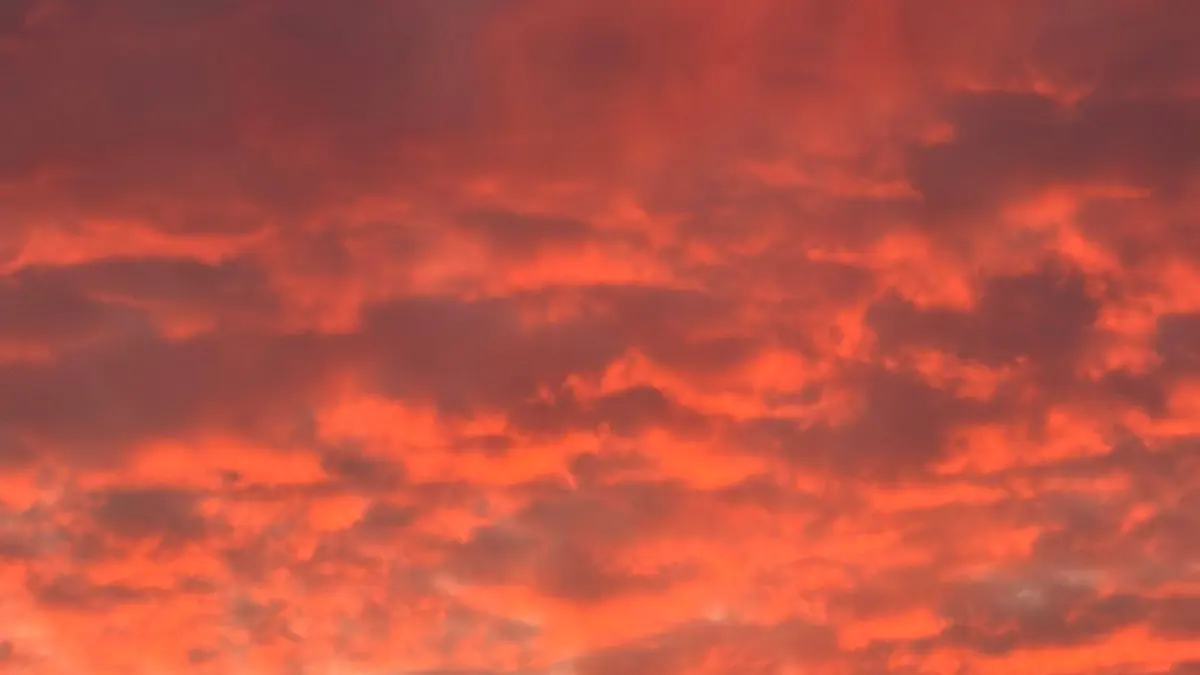
The same sun that looks blinding white at noon turns deep orange or crimson as it approaches the horizon, and the sky around it can flush with pinks and purples that last well after the sun has disappeared. None of this requires anything unusual to be happening in the atmosphere. Sunset colors are the ordinary result of sunlight taking a long, grazing path through air, and the physics behind them is well understood.
Once you know what drives the colors — molecular scattering, particles in the air, and clouds acting as screens — you can do something genuinely useful with that knowledge: predict, with reasonable confidence, whether tonight’s sunset will be worth walking outside for. You can also stop making the most common mistake sunset watchers make, which is leaving too early. The best color frequently arrives after the sun is already down.
Why the Sky Is Blue at Noon and Red at the Horizon
Sunlight looks white, but it contains the full spectrum of visible colors, from short-wavelength violet and blue to long-wavelength orange and red. As sunlight passes through the atmosphere, it collides with molecules of nitrogen and oxygen — particles far smaller than the wavelength of light itself. These collisions scatter light in all directions, and they do it in a strongly wavelength-dependent way. This is Rayleigh scattering, and the key fact is that shorter wavelengths scatter much more strongly than longer ones. Blue light around 450 nanometers scatters several times more efficiently than red light around 650 nanometers.
At midday, this is why the sky is blue: blue light gets scattered out of the direct solar beam and bounced around the atmosphere until it reaches your eyes from every direction. The sun itself still looks essentially white because its light has crossed a relatively short column of air overhead.
At sunset, geometry changes everything. When the sun sits on the horizon, its light reaches you along a grazing path through the atmosphere that is dozens of times longer than the straight-down path at noon. Over that enormous distance, Rayleigh scattering strips away nearly all the blue and green light, scattering it off in other directions long before the beam reaches your eyes. What survives the trip is the long-wavelength end of the spectrum: orange and red. The sun reddens, the light on the landscape warms, and the sky near the horizon glows in the colors that made it through.
The same effect explains why the low sun is dim enough to look at briefly (though you still shouldn’t stare) and why shadows go soft and golden in the last hour of daylight — the window photographers work during golden hour.
Aerosols: The Wild Card in Every Sunset
If molecular scattering were the whole story, every clear sunset would look about the same. It doesn’t, because real air also contains aerosols — dust, sea salt, pollen, smoke, pollution, and water droplets. These particles are comparable in size to the wavelength of light or larger, and they scatter light by a different mechanism called Mie scattering, which is far less selective about color. Mie scattering tends to redirect all wavelengths roughly equally, which whitens and mutes the sky rather than coloring it.
This is why hazy, humid, polluted air usually produces washed-out, milky sunsets: the aerosols scatter white light into your line of sight and bury the reds and oranges under a gray veil. And it’s why some of the crispest, most saturated sunsets come after a cold front passes — the front scours out haze and humidity, leaving clean, dry air where Rayleigh scattering dominates and colors stay pure. Low-humidity autumn and winter air produces vivid sunsets for the same reason.
There’s a famous exception at high altitude. When volcanic eruptions inject sulfur aerosols into the stratosphere, those fine particles can enhance twilight colors worldwide for months. After Krakatoa erupted in 1883, observers across Europe and North America reported sunsets so intensely red that fire brigades were reportedly called out in some towns; the vivid skies persisted for years and appear in paintings from the period. The 1991 eruption of Mount Pinatubo produced a similar, well-documented run of unusually purple and red twilights around the globe. Stratospheric aerosols work differently from low-level haze: they sit above most of the atmosphere and catch reddened sunlight after the sun has set at ground level, lighting the twilight sky from above.
Wildfire smoke is a mixed case. A thin, high layer of smoke can redden the sun dramatically — a blood-red disk hanging in an amber sky. But heavy smoke usually mutes the show rather than enhancing it, dimming the sun to a dull orange smudge and flattening the sky to gray-brown. If the smoke is thick enough to smell, the sunset will more likely be strange than beautiful.
Clouds Are the Projection Screen
A cloudless sunset is usually a modest one: a warm glow at the horizon fading upward into blue. The spectacular sunsets — the ones that fill the whole sky with pink and orange — almost always involve clouds, because clouds are where the color gets displayed.
Here’s the mechanism. After the sun drops below your horizon, its light keeps streaming through the atmosphere overhead. That light has traveled an even longer grazing path than the light you saw at sunset, so it’s even redder. Mid-level and high clouds — altocumulus, altostratus, and especially cirrus — sit high enough to still be in direct sunlight for many minutes after ground-level sunset, and they catch that reddened light on their undersides. The result is clouds lit from below in orange, pink, and magenta against a darkening blue sky.
This is why the best color so often arrives roughly 5 to 15 minutes after sunset, not at sunset itself. At the moment the sun goes down, low clouds near the horizon may still block or dull the light. A few minutes later, the geometry improves: the sun’s rays pass under the low stuff and strike the high clouds from beneath. Watchers who leave at sunset routinely miss the peak of the show. Stay through civil twilight — the 25 to 35 minutes after sunset at most US latitudes — and you’ll catch it.
Cloud type matters. High, thin, textured clouds make the best screens. Thick low overcast makes the worst: it simply blocks the light. The ideal sky is partly cloudy above with a gap of clear sky at the western horizon so the setting sun can shine through underneath and light the clouds from below.
How to Predict a Colorful Sunset
You can’t guarantee a great sunset, but you can stack the odds. Check the forecast and the western sky an hour before sunset and look for these ingredients:
| Factor | What you want | Why it helps |
|---|---|---|
| Cloud cover | Roughly 30–70% | Enough cloud to catch color, enough gap to let light through |
| Cloud height | Mid and high clouds (cirrus, altocumulus) | Stay sunlit longer after sunset; take color from below |
| Western horizon | A clear gap or thin clouds | Lets the low sun’s light reach the clouds overhead |
| Air quality | Clean air, especially after a front | Pure Rayleigh reds instead of hazy gray |
| Humidity | Low | Less white Mie scattering, more saturated color |
A sky that’s 100% overcast will almost never deliver; a sky that’s 100% clear will be pleasant but restrained. The sweet spot is broken cloud with a clean western edge. Timing a cold front helps enormously: the evening after a front clears through, with dry air behind it and departing clouds still overhead, is a classic recipe.
Winter often outperforms summer at most US latitudes, for a stack of reasons. Winter air is drier and frequently cleaner, so colors stay saturated. Storm systems leave behind dramatic broken cloud decks. And the sun sets at a shallower angle in winter at mid-latitudes, which stretches the color phase slightly — the sun spends more clock time near the horizon. As a bonus, winter sunsets happen at civilized hours; in Seattle in December, the whole show is over before 4:45 p.m.
Don’t Forget to Look East
Almost everyone watches a sunset facing west. Turn around. In clear air, the eastern sky at sunset displays two subtle phenomena worth knowing.
The first is the Belt of Venus, also called the anti-twilight arch: a soft pink band hovering above the eastern horizon, produced by reddened sunlight backscattered off the atmosphere opposite the sun. Below it lies the second feature — Earth’s shadow itself, a blue-gray band hugging the horizon. That dark band is literally the shadow of the planet you’re standing on, cast onto the atmosphere. As the sun sinks lower behind you, the shadow rises in the east, pushing the pink belt upward until both dissolve into the darkening sky. The effect is most visible from an open eastern horizon in the 10 to 20 minutes after sunset, and it’s just as striking before sunrise, mirrored in the west.
Catching the Show
The practical routine is simple. Check the cloud forecast in the afternoon — you’re hoping for broken mid or high clouds with a clear slot at the western horizon, ideally in clean post-frontal air. Look up the exact sunset time for your location and arrive 15 to 20 minutes early to watch the light warm through the last of golden hour. Then, critically, stay at least 15 to 20 minutes past sunset. The underlit-cloud phase peaks after the sun is down, and the deep blues and magentas of early twilight — the window covered in our blue hour guide — follow right behind it. Glance east for the Belt of Venus and Earth’s shadow while you wait. The sky runs the whole sequence in about 40 minutes, and the only way to miss it is to leave early.