How Elevation and Your Horizon Change Sunrise and Sunset Times
See what this means where you live
Choose a place and an optional date for sunrise, sunset, golden hour, and twilight. Leave the date blank for today.
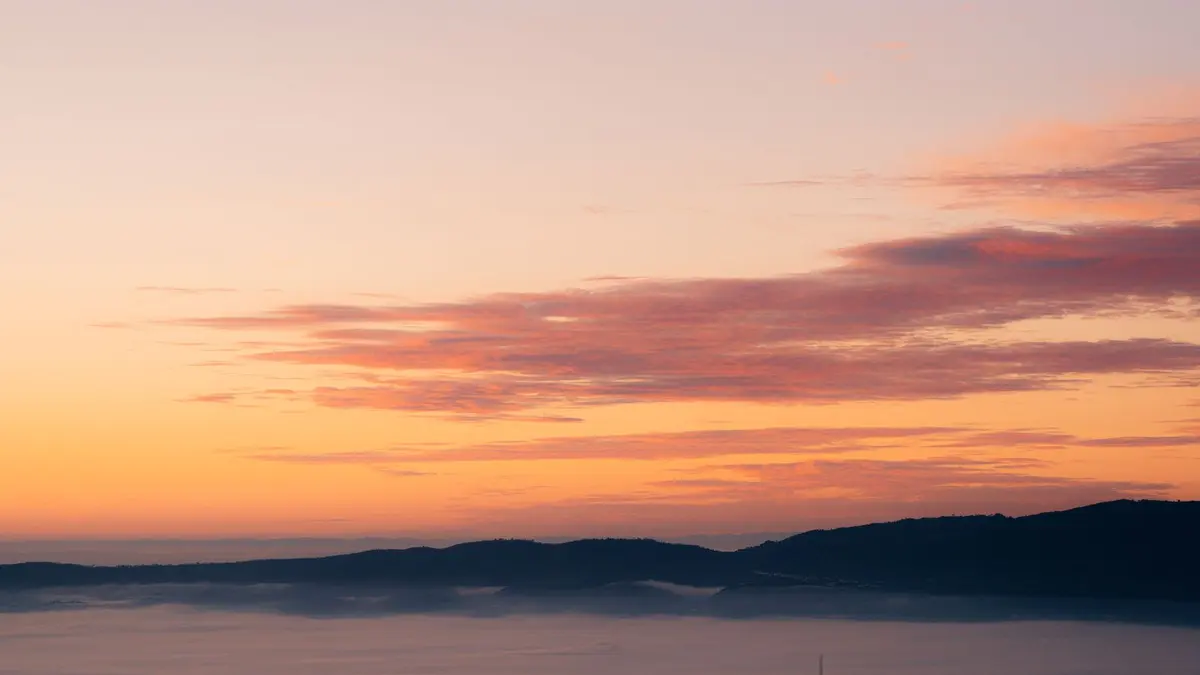
Every sunrise and sunset time you’ll find on this site — or in a weather app, or a printed almanac — rests on a quiet assumption: that you’re standing at sea level looking out at a flat, unobstructed horizon, like a ship at sea. For a lot of the country that’s close enough. But if you live in the mountains, at the bottom of a valley, on a high plain, or among tall buildings, your real-world sunrise and sunset can differ from the published time by several minutes — sometimes much more. Here’s why, and how to think about the difference.
The standard assumption
Astronomical sunrise is defined as the moment the upper edge of the Sun first appears over an ideal sea-level horizon, with a standard correction built in for how the atmosphere bends light. Sunset is the mirror image: the moment the upper edge disappears below that same ideal horizon. These definitions are precise and universal, which is what makes calculated times comparable from one city to the next.
The catch is that almost nobody has a perfect sea-level horizon. The real horizon you can see is shaped by the land — and that reshaping moves the times.
Your own elevation makes the day longer
Start with altitude. If you climb a mountain or stand on a rooftop, you can see slightly over the curve of the Earth. That lowers your visible horizon below the flat, eye-level line — which means you catch the Sun a little earlier in the morning and hold onto it a little later in the evening.
The effect is real and measurable. A modest hill won’t do much, but at a few thousand feet it adds up to a handful of minutes on each end of the day. On a high peak — thousands of feet above the surrounding terrain — you can gain several minutes of sunrise and sunset compared to someone at sea level at the same latitude and longitude. It’s the same reason the top of a tall building catches the last light of sunset while the street below is already in shadow: the higher observer sees a lower, farther horizon.
This is a genuine lengthening of the visible day. It’s why mountaintops glow after the valleys have gone dark, and why alpine climbers get their light earlier than the towns below them.
The terrain around you can shorten it a lot
Now the opposite, and usually the bigger effect: what’s in front of you.
If you live in a valley, a canyon, or a town ringed by hills, the Sun doesn’t rise when it clears the mathematical horizon — it rises when it clears the ridgeline. A mountain to your east can delay sunrise by many minutes, or in a deep valley by an hour or more. A ridge to your west can end your day’s direct sunlight well before the calculated sunset. In the deepest canyons and narrowest valleys, the “official” sunrise and sunset times can be almost meaningless for daily life; what matters is when the Sun tops the wall and when it drops behind the far one.
Cities do the same thing at a smaller scale. A wall of buildings to the east or west acts like an artificial ridgeline, cutting minutes off each end of your usable daylight even though the astronomical times are unchanged. This is why the calculated sunset can still read “8:41 PM” while the street you’re standing on went into shade twenty minutes earlier.
Why the calculated time is still the right baseline
Given all this, you might ask why anyone publishes a single sunrise and sunset time at all. The answer is that the terrain correction is intensely local — it depends on the exact ridgeline in your particular direction, which changes if you walk a few hundred yards down the road. There’s no single “valley correction” that would be right for everyone in a town.
So the sea-level, flat-horizon figure serves as a consistent, well-defined baseline. It tells you when the Sun crosses the true horizon; you then adjust for your own surroundings based on what you can actually see. Two useful rules of thumb:
- Higher up, or looking out over lower ground: expect the Sun a little earlier at sunrise and a little later at sunset than the published time.
- Ringed by hills, mountains, or buildings: expect the Sun later at sunrise and earlier at sunset — often by a lot more than the elevation effect, and easily the dominant factor if you’re in a valley or a dense city.
Getting a feel for your own horizon
The simplest way to know your real sunrise and sunset is to watch them a few times and compare against the calculated figure for your city. If the Sun consistently appears ten minutes after the published sunrise, you’ve effectively measured your eastern ridgeline — and that offset will hold steady, because the terrain doesn’t move. Photographers and hikers do exactly this: once you know your local horizon, you can take any calculated time and mentally shift it to match the ground you’re standing on.
The times on this site are computed from each city’s center coordinates against a standard unobstructed horizon, so they’re a clean astronomical baseline rather than a promise about what you will see. Treat them as the anchor, then add your own view of the world — the hill to the east, the valley wall to the west, the twenty floors beneath your window — to estimate when the light will really reach you.