Why Darkness Falls Faster in Miami Than in Seattle: Twilight Length by Latitude
See what this means where you live
Choose a place and an optional date for sunrise, sunset, golden hour, and twilight. Leave the date blank for today.
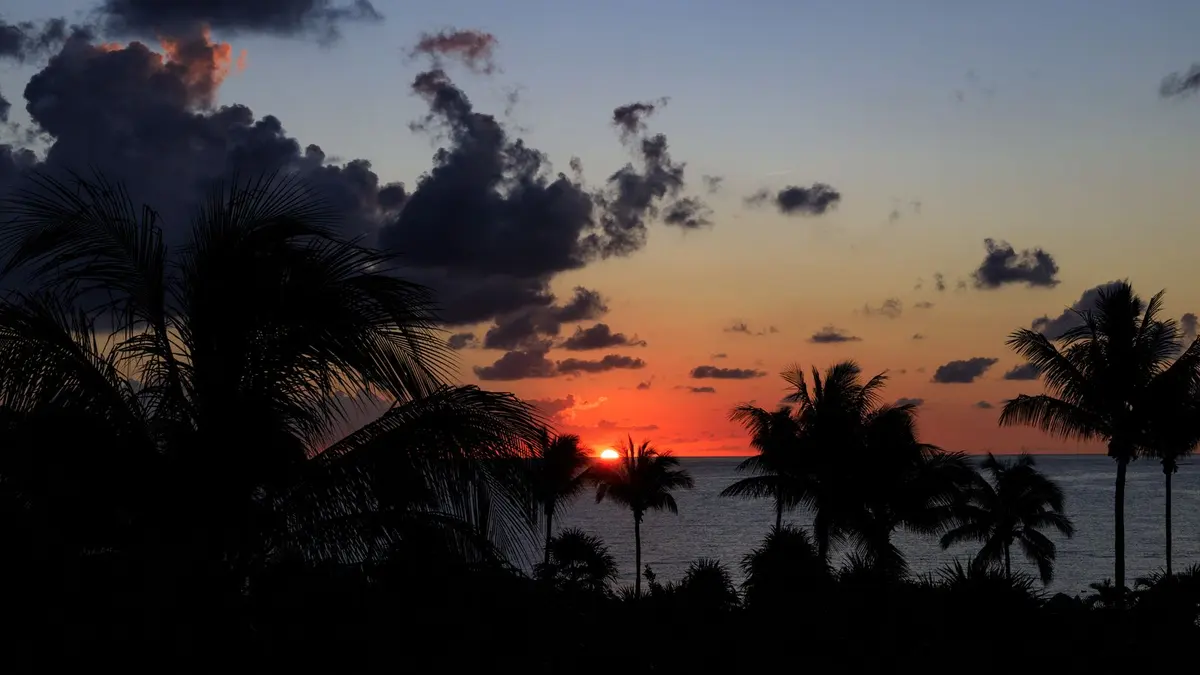
Visitors from the northern US are often startled by how abruptly night arrives in the tropics. In Miami or Key West, the sun goes down and the sky seems to snap to dark within about twenty minutes. Meanwhile, a July evening in Seattle lingers: the sun sets after 9 p.m. and usable light hangs on toward 10. Go further north still, to Fairbanks or even Anchorage in midsummer, and “night” barely happens at all — the sky stays in a pale glow from sunset to sunrise.
None of this has to do with air quality, humidity, or being near the ocean, although people reach for all of those explanations. It’s pure geometry. The length of twilight is set by one thing: the angle at which the sun’s path crosses the horizon. That angle is determined by your latitude, modified by the season, and it produces differences big enough to matter for photographers, stargazers, drivers, and anyone planning an evening outdoors.
The Sun Doesn’t Set Straight Down (Except Near the Equator)
Twilight is the period after sunset (or before sunrise) when the sun, though below the horizon, still lights the upper atmosphere. It’s conventionally divided into bands by how far the sun has sunk: civil twilight ends when the sun reaches 6° below the horizon, nautical at 12°, astronomical at 18° — the full breakdown is in our guide to the three twilight phases. So the question “how long does twilight last?” reduces to: how long does the sun take to descend those degrees?
The sun’s apparent motion across the sky is essentially constant everywhere on Earth — about 15° per hour, one full circle per day. What varies is the direction of that motion relative to your horizon.
Stand on the equator at an equinox and the sun’s daily circle is perpendicular to the horizon. At sunset, the sun drops straight down, converting nearly all of its 15°-per-hour motion into vertical descent. Six degrees below the horizon takes barely over 20 minutes; 18 degrees — full astronomical darkness — arrives in a bit over an hour. Night falls like a curtain.
At higher latitudes, the sun’s daily circle is tilted over. At 47°N, the circle leans roughly 47° from vertical, so at sunset the sun isn’t plunging — it’s sliding sideways along the horizon while sinking slowly. Only part of its 15°-per-hour motion goes into losing altitude. The same 6° of descent takes much longer, and twilight stretches accordingly. Push the latitude high enough and the sun’s path becomes so shallow that it grazes along below the horizon for hours without ever getting deep enough for real darkness.
Miami, Seattle, Anchorage: The Numbers
Here’s roughly how evening civil twilight (sunset until the sun is 6° down) compares across three US latitudes:
| City | Latitude | Civil twilight, equinoxes | Civil twilight, June solstice |
|---|---|---|---|
| Miami, FL | ~25.8°N | ~23 min | ~26 min |
| Seattle, WA | ~47.6°N | ~30 min | ~40+ min |
| Anchorage, AK | ~61.2°N | ~40 min | all night |
Miami’s civil twilight holds remarkably steady — roughly 20 to 26 minutes all year. That’s the signature of low latitude: the sun always meets the horizon steeply, in every season. When Floridians say it gets dark fast, they’re right, and it’s true in January and July alike.
Seattle’s twilight is longer in every season and swings more: around half an hour near the equinoxes, stretching past 40 minutes in midsummer. And Seattle’s full progression to darkness is dramatically longer — around the June solstice, the sun never reaches 18° below the horizon at all, so astronomical twilight lasts all night and true darkness never arrives for a few weeks.
Anchorage, at 61°N, crosses into genuinely polar-flavored territory. For several weeks around the June solstice, the sun never sinks even 6° below the horizon — civil twilight literally lasts from sunset to sunrise. These are the “white nights”: you can read a newspaper outdoors at 1 a.m. Fairbanks, three degrees further north, goes further still, with the sun barely dipping below the horizon at all in late June. Neither city sees the true midnight sun — that requires crossing the Arctic Circle at 66.6°N, as in Utqiaġvik, where the sun stays up continuously for about 80 days — but functionally, midsummer night in much of Alaska is just a long, dim dusk.
The same geometry runs in reverse in winter: above the Arctic Circle the sun can fail to rise at all (polar night), while Anchorage bottoms out with about 5.5 hours of daylight — short, but bracketed by those characteristically long, slow northern twilights.
Why Season Changes the Answer
Latitude sets the baseline, but the season adjusts it, and the pattern is worth knowing: at mid and high latitudes, twilight is longest around the summer solstice and shortest near the equinoxes.
The equinox minimum surprises people. The reason is that at an equinox the sun sets due west and crosses the horizon at the steepest angle your latitude allows, so it exits downward as efficiently as it ever does. Near the June solstice, the sun sets far to the northwest and its path after sunset skims shallowly below the northern horizon, taking its time getting to 6° down — and much more time getting to 18°. (There’s a smaller secondary bump around the winter solstice too, when the sun sets in the southwest at a similarly slanted angle, which is why December twilights at northern latitudes also run a bit long.)
At Miami’s latitude, all of these effects are compressed: the seasonal swing in civil twilight is only a few minutes. At Seattle’s, it’s ten minutes or more for civil twilight and unbounded for astronomical. This is a cousin of the broader pattern in how daylight hours vary across the United States — latitude amplifies every seasonal effect.
What This Means in Practice
Photographers get a longer blue hour up north. The blue hour — that window of deep, even, blue-toned light when the sun is roughly 4–8° below the horizon — is directly rationed by twilight speed. In Miami it’s a brisk 15–20 minutes and you’d better have your composition ready. In Seattle in June, the equivalent light can stretch past half an hour, and the whole dusk sequence unfolds at a forgiving pace. If you’ve ever wondered why northern-latitude cityscape shots seem to catch that perfect dusk balance so often, part of the answer is simply that the window is wider. Our blue hour photography guide covers how to work it.
Stargazers in the northern US lose true darkness in midsummer. Astronomical darkness requires the sun to be 18° down. Around the June solstice, that never happens above roughly 48.5°N — a line that runs near Seattle, and everything north of it: northern Washington, Glacier National Park’s latitude, northern Minnesota, northern Maine. For a few weeks, the sky at 1 a.m. still carries a faint permanent glow along the northern horizon, washing out faint galaxies and the Milky Way’s subtler structure. Southern observers never face this; Miami gets full astronomical darkness every night of the year, a bit over an hour after sunset. If you’re planning a dark-sky trip, this matters as much as moon phase — see when it’s truly dark for stargazing.
Travelers should recalibrate. A hiker from Minnesota used to a long, gentle dusk can get caught out on a Costa Rica or Hawaii trail (Honolulu sits at 21.3°N, more tropical than Miami) when full darkness arrives 45 minutes after a sunset that seemed to promise a leisurely walk back. In the tropics, treat sunset time as a hard deadline minus twenty minutes, not the start of a long fade. The reverse surprise is pleasant: visitors to Alaska or even northern Europe in June discover they can hike, fish, or shoot photos at 11 p.m.
Drivers face different dusk profiles. The tricky low-light transition — headlights needed, eyes not yet adapted — is short and sharp in the South, long and drawn-out in the North. Neither is inherently safer, but the southern version compresses the adjustment into minutes.
Reading Your Own Twilight Times
You don’t have to estimate any of this. Twilight start and end times are computed astronomically for any location and date — our daily pages list civil, nautical, and astronomical twilight alongside sunrise and sunset. A useful habit: check the gap between sunset and the end of civil twilight for your city today, then check it again at the solstice and the equinox. In Tampa the number will barely move; in Duluth it will swing visibly with the seasons. That gap is your real “usable light after sunset” budget — and once you know how latitude sets it, a Miami nightfall and an Anchorage white night stop being surprises and become the same simple geometry, viewed from two different places on a tilted, spinning sphere.